Marilyn Nelson read some of her poetry tonight at the University of Bridgeport. As she described circumstances in which the poems were written and engaged in q/a, theological meanings and images were surfaced. I was especially intrigued by the interplay of themes around issues related to 'momma' (simultaneously girl, her mom, and God), body (we are not 'only' body but timelessly ensouled), and freedom and courage that exceeds the bounds with which others may try to yoke us.
Check out her bio and get to know her work.
Thursday, September 15, 2011

Wednesday, September 7, 2011
Insights from Irene
Irene rolled into Connecticut by night. By morning (8:00 a.m. on my street), the lights were out. It would not be restored for days; some parts of the northeast had it far worse.
We had been waiting for the storm because contemporary metereology identifies the path of hurricanes early in their development. As we waited, I noted the following:
People vacillate between worrying for the worst and scoffing at the claims of danger. Maintaining a reasoned, balanced assessment of risk is difficult for most and impossible for many.
People don't want to go without water and bread. These were the two items that sold out at the grocery store in tbe days before Irene. Other food sold well, but bread and water sold out.
Some people like icecream so much that the threat of a power outage means nothing. In tbe grocery store, as I waited to check out with my $200 worth of crackers and other dry foods, a young couple ahead of me was paying for three half gallons of cookies and cream. It was so far removed from the coming storm that it seemed an almost perfect NT parable of the Kingdom of Heaven. I looked around for Jesus, but he was nowhere to be found. He was probably combing the store looking for water.
Speaking of the Kingdom and groceries: there were two types of end-timers. Those who refused to budge an inch, and those who yielded perfectly and completely to Irene. The non-budgers were buying items that go bad with a few hours loss of refrigeration. Sushi! Good anytime, assuming it's been kept cold. The yielders were not more anxious, I think. Many took delight in sharing dark stories of flood and peril. If this group was on Noah's ark, they'd have brought jars of peanuts.
After the storm struck, I noted a few other things:
Power is important to people. Electricity, digital connections, washers, dryers, stoves, refrigerators--it's hard to do without these things once expectations and assumptions are framed with their availability.
Warm food is healing. Whoever invented the use of fire to cook food, I propose, should be named Adam. (I am assuming that the first cooking was outside, and so fell to men. Only later, with intensified civilization, was it moved inside and remanded to women.) After a few days without warm food, a heated pop tart is tastier and more to be desired than salmon seviche.
Hot coffee is holy.
Our reliance on digital media has led to our ignoring of neighbors. Each night after work, we neighbors stood in our front yards and compared notes, worries, and complaints. These acts resonated deeply; they followed patterns that are hundreds of thousands of years old. But in the last decade, we have set much of that aside, because our attentions are drawn to the worlds of digital media. Something important has been lost.
Remembering lessons is hard; acting upon them is nigh impossible. The storm is gone. The power is back. What was all the fuss about?
We had been waiting for the storm because contemporary metereology identifies the path of hurricanes early in their development. As we waited, I noted the following:
People vacillate between worrying for the worst and scoffing at the claims of danger. Maintaining a reasoned, balanced assessment of risk is difficult for most and impossible for many.
People don't want to go without water and bread. These were the two items that sold out at the grocery store in tbe days before Irene. Other food sold well, but bread and water sold out.
Some people like icecream so much that the threat of a power outage means nothing. In tbe grocery store, as I waited to check out with my $200 worth of crackers and other dry foods, a young couple ahead of me was paying for three half gallons of cookies and cream. It was so far removed from the coming storm that it seemed an almost perfect NT parable of the Kingdom of Heaven. I looked around for Jesus, but he was nowhere to be found. He was probably combing the store looking for water.
Speaking of the Kingdom and groceries: there were two types of end-timers. Those who refused to budge an inch, and those who yielded perfectly and completely to Irene. The non-budgers were buying items that go bad with a few hours loss of refrigeration. Sushi! Good anytime, assuming it's been kept cold. The yielders were not more anxious, I think. Many took delight in sharing dark stories of flood and peril. If this group was on Noah's ark, they'd have brought jars of peanuts.
After the storm struck, I noted a few other things:
Power is important to people. Electricity, digital connections, washers, dryers, stoves, refrigerators--it's hard to do without these things once expectations and assumptions are framed with their availability.
Warm food is healing. Whoever invented the use of fire to cook food, I propose, should be named Adam. (I am assuming that the first cooking was outside, and so fell to men. Only later, with intensified civilization, was it moved inside and remanded to women.) After a few days without warm food, a heated pop tart is tastier and more to be desired than salmon seviche.
Hot coffee is holy.
Our reliance on digital media has led to our ignoring of neighbors. Each night after work, we neighbors stood in our front yards and compared notes, worries, and complaints. These acts resonated deeply; they followed patterns that are hundreds of thousands of years old. But in the last decade, we have set much of that aside, because our attentions are drawn to the worlds of digital media. Something important has been lost.
Remembering lessons is hard; acting upon them is nigh impossible. The storm is gone. The power is back. What was all the fuss about?
Friday, August 19, 2011
Let us reason together
"Come now, let us reason together saith the Lord: though your sins be as scarlet, they shall be as white as snow; though they be red like crimson, they shall be as wool."
Isa. 1:18, KJV
The first book of Isaiah contains some of the Hebrew Bible's most beautiful passages. There are worrisomely dark clouds of judgments and calls to repentance--a promise of redemption. At once threatening and consoling, the portrayal of God is remarkably textured and subtle.
The texts are not primarily aimed to individuals, but to the people as a whole--to the nation.
"For unto us a child is born, unto us a son is given: and the government shall be upon his shoulder: and his name shall be called Wonderful, Counseller, The mighty God, The everlasting Father, The Prince of Peace."
Isa. 9:6, KJV
Christians (for them, quite correctly) see this latter passage as prophecy of the Christ (Messiah), but the original sense was about God's redemption of Israel. The terms are striking and wonderful. "The people who walked in darkness have seen a great light..." (9:2).
Apart from the original meanings (whatever they were) and from those Christianity found in these passages, these texts reverberate with 'divine' energy. They combine starker judgment than we modern liberals like to express, but they situate judgment in compassion and care that exceeds our imaginations.
Much current discussion about God is more certain--more strident--than can be supported by Isaiah's claims. These texts call us to a less certain and more dynamic sense of the divine.
Isa. 1:18, KJV
The first book of Isaiah contains some of the Hebrew Bible's most beautiful passages. There are worrisomely dark clouds of judgments and calls to repentance--a promise of redemption. At once threatening and consoling, the portrayal of God is remarkably textured and subtle.
 |
| Michelangelo's Isaiah image courtesy of wikimedia |
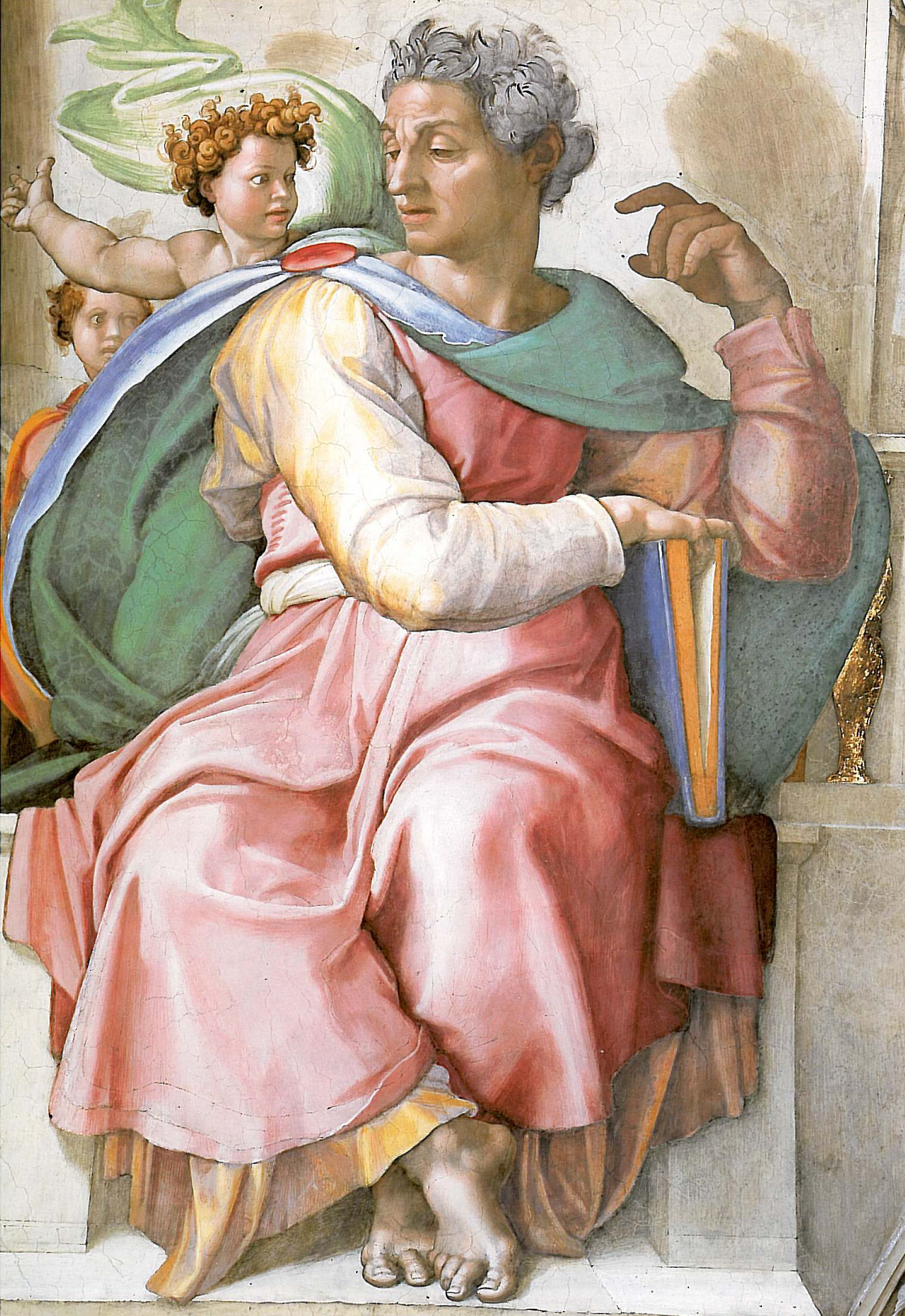
The texts are not primarily aimed to individuals, but to the people as a whole--to the nation.
"For unto us a child is born, unto us a son is given: and the government shall be upon his shoulder: and his name shall be called Wonderful, Counseller, The mighty God, The everlasting Father, The Prince of Peace."
Isa. 9:6, KJV
Christians (for them, quite correctly) see this latter passage as prophecy of the Christ (Messiah), but the original sense was about God's redemption of Israel. The terms are striking and wonderful. "The people who walked in darkness have seen a great light..." (9:2).
Apart from the original meanings (whatever they were) and from those Christianity found in these passages, these texts reverberate with 'divine' energy. They combine starker judgment than we modern liberals like to express, but they situate judgment in compassion and care that exceeds our imaginations.
Much current discussion about God is more certain--more strident--than can be supported by Isaiah's claims. These texts call us to a less certain and more dynamic sense of the divine.
Sunday, July 17, 2011
Reality?
Thinkers and sages as various as Immanuel Kant, the Buddha, St. Paul, Sigmund Freud--and countless others--have argued or shown that we have a limited grasp of reality. Not only is reality cognitively mediated, it is reordered and construed by our interests, needs, desires, and fears. Much of the mind's power is dedicated to preventing our grasp of reality.
Then we also scrimp around and find substances, practices, or beliefs that further inhibit the mind's powers and clarity.
So what lies beneath the haze? That would be an interesting thing to know.
Then we also scrimp around and find substances, practices, or beliefs that further inhibit the mind's powers and clarity.
So what lies beneath the haze? That would be an interesting thing to know.
Thursday, July 14, 2011
Prayer
A prayer is.
Doubt that.
What is the sound of one prayer praying
of one brick layer laying
of one child playing?
Hear that?
Either every dot is connected in the universe
or someone is (or many are) still seeking pencil-in-hand for the next number
and a prayer is, ahem, prodding him or her or them right-left-back-and/or-fro.
When all the dots are connected
one suspects the picture will be a tad underwhelming
but it will neither be a frown
nor evoke one from those holding pencils.
Doubt that.
What is the sound of one prayer praying
of one brick layer laying
of one child playing?
Hear that?
Either every dot is connected in the universe
or someone is (or many are) still seeking pencil-in-hand for the next number
and a prayer is, ahem, prodding him or her or them right-left-back-and/or-fro.
When all the dots are connected
one suspects the picture will be a tad underwhelming
but it will neither be a frown
nor evoke one from those holding pencils.
Wednesday, May 25, 2011
Abiding

The wall here reflects the glory of an unseen (and unseeable) divinity; it also is the work of men and women. Perhaps it is primarily for that reason it mirrors a divine presence. The mortality of our actions and life is a work in the face of an eternal tomorrow.
Once this structure was a drawing or an idea. Then it was produced, first in its individual elements (bricks, mortal, windows). After a period of energetic activity, it was a newly completed structure.
The story of this structure is unknown to me, but at some point (it appears) to have been decommissioned. Now it simply abides.
Friday, April 29, 2011
Saturday, April 23, 2011
Sunday, March 20, 2011
Tuesday, March 15, 2011
Kingdom of God
All the changes afoot on the world stage commend a point of view about the Kingdom of God: it is not (mainly) within our souls, and it is more dangerous than we typically realize.
Beware, God is on the prowl.
Beware, God is on the prowl.
Tuesday, March 1, 2011
Whither wishful thinking and origins of violence?
With a nod to St. Sigmund, and recognition of the need for St. Augustine...
In a reflection on the revolutions shaking North Africa, I cited Shakespeare's 'wish is father to the thought' motif over at RITN. In the compass of a few brief lines, the entry moved from wishing for Al Qaeda's marginalization to supporting a military intervention to lay Qaddafi low. Much is at stake in Libya, and violence is inescapable. Ignoring the Colonel's attacks on his own people is not viable, but it is worth pondering the origin of violent wishes and actions.
The reference to Henry IV points to parricidal rage, to deliberate ego/counter-ego (mis)representations, which simultaneously claim moral high ground and do the dirty work of history. Induced by desire for kingly glory, Hal wishes for the death of his father, but then turns against Falstaff ('I know thee not, old man'), the symbol of fulfilling desires, after his desires have been realized.
Moral polyvalence prevails in in the work of nations (witness the long-term US support of Mubarak and warming up to Qaddafi as a point against terrorists, and then also our turn against them when democratic 'values' required it) every bit as much as it does in the psyche. At least in part,Violence is an act against our own representations of the other and a not very veiled act of violence against our self in its ma/paternal origins.
Does violence spring from the sinews of our selves? If not, whence arises this wish to destroy? Augustine and Freud, taken together, only begin to answer these questions....
In a reflection on the revolutions shaking North Africa, I cited Shakespeare's 'wish is father to the thought' motif over at RITN. In the compass of a few brief lines, the entry moved from wishing for Al Qaeda's marginalization to supporting a military intervention to lay Qaddafi low. Much is at stake in Libya, and violence is inescapable. Ignoring the Colonel's attacks on his own people is not viable, but it is worth pondering the origin of violent wishes and actions.
The reference to Henry IV points to parricidal rage, to deliberate ego/counter-ego (mis)representations, which simultaneously claim moral high ground and do the dirty work of history. Induced by desire for kingly glory, Hal wishes for the death of his father, but then turns against Falstaff ('I know thee not, old man'), the symbol of fulfilling desires, after his desires have been realized.
Moral polyvalence prevails in in the work of nations (witness the long-term US support of Mubarak and warming up to Qaddafi as a point against terrorists, and then also our turn against them when democratic 'values' required it) every bit as much as it does in the psyche. At least in part,Violence is an act against our own representations of the other and a not very veiled act of violence against our self in its ma/paternal origins.
Does violence spring from the sinews of our selves? If not, whence arises this wish to destroy? Augustine and Freud, taken together, only begin to answer these questions....
Friday, February 25, 2011
Over @ Creedible.com
Join me over at Creedible.com to discuss Cell phones and prayer. Make the call...
Subscribe to:
Posts (Atom)
LinkWithin
